Christmas Goose Sweater Embroidery
A Cheerful, Farmhouse-Ready Design—But Not for Every Fabric or Fit
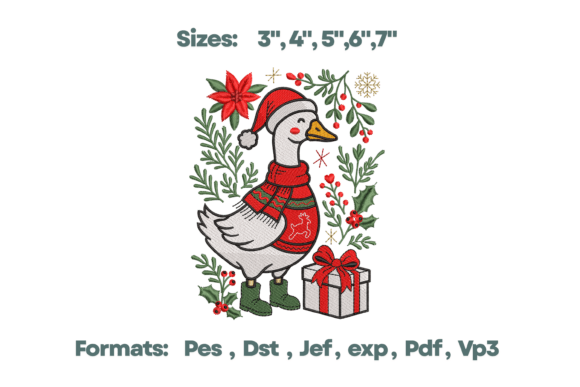
As someone who’s stitched hundreds of holiday designs across apparel, home goods, and boutique merchandise, I opened the Christmas Goose Sweater Embroidery file expecting charm—and got it instantly. This isn’t a generic snowman or glittery tree; it’s a warm, character-driven machine embroidery design with clear personality: a plump goose in a reindeer sweater, jaunty Santa hat, and rubber boots. The mood is cozy, nostalgic, and gently humorous—perfect for farmhouse Christmas decor, handmade gifts, or small shop branding that leans into authenticity over polish.
I tested it first on a medium-weight cotton twill tote bag—my go-to for client gift samples—and the result landed exactly where I hoped: friendly, legible at 4.5 inches wide, and full of visual warmth without overwhelming the fabric. Customers notice this kind of detail. One local boutique owner told me her shoppers paused mid-aisle to point at a similar goose design on a tea towel—and bought three. That’s the power of intentional character work in a holiday embroidery file.
Where It Shines (and Where It Needs Caution)
The Christmas Goose Sweater Embroidery excels in projects where storytelling matters more than sharp precision: embroidered pillow covers for nursery decor, baby onesies (with careful stabilizer), aprons for bakeries or craft studios, and kitchen towels for holiday markets. Its rounded shapes and moderate detail level hold up beautifully on textured fabrics like linen blends or brushed cotton—no micro-stitching to snag or blur.
That said, I wouldn’t use it straight out of the box on thin jersey tees or stretchy baby knit without adjusting stitch density and testing stabilizer layers. The sweater’s fill stitch areas are generous—not overly dense, but not sparse either—and they can pucker on lightweight or unstable fabric. On dark fabric, the contrast works best when thread colors are rich (think burgundy sweater, forest green boots) rather than pastel; always test your thread palette against the base before stitching a finished product.
Caps and curved surfaces? Proceed thoughtfully. The goose’s round body adapts well to gentle curves, but the Santa hat’s brim and boot details sit near the outer edges—so if you’re hooping a low-profile cap, reposition the design slightly inward and confirm clearance during your test run. No tiny lettering or fine outlines here, which is a relief—it means fewer headaches on small hoops or delicate garments.
Real Use, Real Impact
Last week, I stitched the Christmas Goose Sweater Embroidery onto a set of organic cotton sweatshirts for a local children’s boutique. We used tear-away + cut-away hybrid stabilizer, 40-weight polyester thread, and kept the design under 5 inches tall. The result? A cohesive, hand-finished look—not “machine-made” but “thoughtfully made.” Parents commented on how “sweet but not cutesy,” and several asked if we’d do matching sibling sets. That’s the quiet strength of this design: it invites connection, not just decoration.
For Etsy sellers and craft fair vendors, this embroidery file fits neatly into multiple listings: as a standalone digital embroidery file, as part of a holiday bundle, or pre-stitched on a ready-to-ship item like a patch or tea towel. Its farmhouse charm pairs well with neutral backdrops in printable mockups—no need for heavy props or seasonal clutter. Just the goose, clean fabric, and natural light says enough.
Design Notes You’ll Actually Use
- Always test on scrap fabric first—especially if you’re using it on layered garments (like a quilted jacket) or textured surfaces (burlap, terry cloth).
- Review stitch density visually before sending to your machine. Look for balanced fill areas—none should feel “heavy” or “thin” compared to the rest.
- Confirm hoop size compatibility. While the design fits comfortably in a 5x7 hoop, check whether your version includes alternate sizes—if not, avoid scaling beyond 10% up or down.
- Inspect small details in black-and-white mockups. The rubber boots and sweater pattern rely on shape and contrast more than intricate line work, so they translate well—but verify clarity on both light and dark backgrounds.
- Use proper stabilizer for your fabric type. Medium-weight cut-away for knits, tear-away for stable wovens, and fusible + tear-away for nap-free fleece.
- Check licensing terms before selling finished items or digital products. If you plan to offer this as part of a craft kit, subscription box, or commercial embroidery service, confirm whether the license permits resale of stitched goods or redistribution of the embroidery file itself.
More Than Just a Holiday Gag
What makes the Christmas Goose Sweater Embroidery stand out isn’t novelty—it’s intention. The proportions are balanced, the theme is specific without being limiting, and the visual weight feels right for real-world use. It doesn’t try to be everything: no snowflakes, no bells, no “Merry Christmas” banner tacked on. It’s just one cheerful goose, fully dressed for the season—and that restraint is why it works so well across product types.
For small business owners building a recognizable aesthetic, this design reinforces warmth and approachability. For hobbyists making personalized gifts, it adds instant personality without demanding advanced technique. And for apparel decorators, it’s a reliable, conversation-starting asset that performs consistently—once you’ve matched it to the right fabric and stabilizer combo.
In short: the Christmas Goose Sweater Embroidery earns its place in your holiday design assets—not because it’s flashy, but because it’s thoughtful, adaptable, and quietly memorable. Stitch it right, and it won’t just decorate a product. It’ll make someone smile while unloading groceries, tie a baby shower gift together, or become the quiet highlight of a holiday market stall. That’s the kind of embroidery that lasts beyond December.