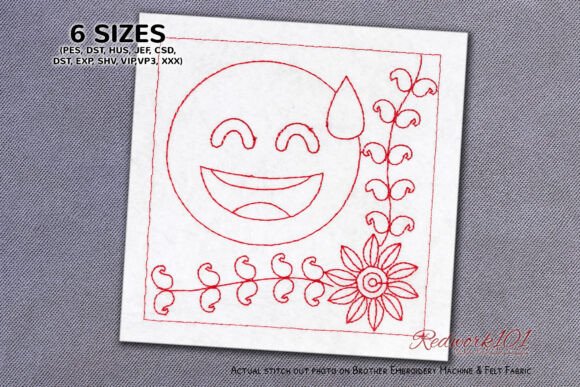
Pretty Smiling Face with Sweat Redwork
A Playful, Hand-Drawn Vibe That Lands Just Right
Opening Pretty Smiling Face with Sweat Redwork for the first time, I immediately felt its personality: cheerful but not cloying, nostalgic but fresh, simple in concept yet rich in detail. As an embroidery designer who’s stitched hundreds of face motifs for boutique apparel, I appreciate how this redwork design balances expressive charm with clean execution. The smiling face carries warmth and lightness—the kind that reads well at 3” chest placement on a hoodie or scaled up to 5.5” across a tote bag. The single sweat drop adds gentle narrative tension; it’s not anxious—it’s *alive*, like someone just laughed hard on a sunny afternoon. Floral flourishes and delicate swirls wrap the composition without overcrowding, giving it visual breathing room. It feels intentionally inspirational, not generic—more “handmade joy” than clipart. For small shop owners building a cohesive brand voice, this isn’t filler—it’s a mood anchor.
How It Performs Across Real Apparel Projects
Sweatshirt embroidery is where Pretty Smiling Face with Sweat Redwork shines brightest. On heather grey or oatmeal fleece, the redwork contrast pops without shouting—ideal for a curated, soft-spoken boutique aesthetic. I tested it centered on a relaxed-fit crewneck: the curved neckline didn’t distort the stitch path, and the floral vines followed the natural drape beautifully. For hoodie design, chest placement stays balanced—even on oversized silhouettes—because the motif’s vertical proportion (face + drop + florals) avoids top-heaviness. A sleeve accent? Yes—but keep it above the elbow where fabric tension stays stable. Back designs work well too, especially when paired with minimal text (e.g., “Breathe Easy” in matching thread).
On t-shirt embroidery, I recommend using a lightweight cutaway stabilizer beneath mid-weight cotton. The design’s moderate stitch density holds up cleanly—no puckering—though avoid placing it directly over side seams or armpit curves where stretch could pull stitches. For denim jackets, switch to 40-weight rayon or polyester thread for subtle sheen against rigid twill; the redwork’s line weight translates surprisingly well into that textured background. And on tote bags? This is where the design becomes a quiet branding tool—visible enough to spark conversation, refined enough to feel intentional next to artisan coffee or indie bookstore merch.
Where to Place It—and Where to Pause
Small chest placement (2.75”–3.25”) works reliably across most unisex sweatshirts and hoodies. But don’t force it onto ribbed fabric without testing: the alternating knit/purl columns can cause slight distortion in fine swirl lines. Likewise, dense floral zones near the face’s temples need extra stabilizer support on stretchy French terry or brushed poly blends. Curved surfaces—like the rounded front of a baseball cap or the shoulder seam of a cropped hoodie—require careful hooping and possibly digitized repositioning (if your machine allows). Avoid pairing Pretty Smiling Face with Sweat Redwork with tiny lettering underneath; its expressive energy dominates space, so let it breathe solo or with ample negative space.
Impact Beyond the Stitch
This machine embroidery design subtly elevates perceived value. Because it reads as hand-drawn—not algorithmically generated—it supports a handmade product story that resonates with Etsy shoppers and conscious consumers. When used consistently across a seasonal collection (e.g., matching sweatshirts, totes, and kids’ tees), it builds visual recognition faster than abstract graphics. Buyers begin to associate that smile + sweat drop + vine motif with your boutique brand’s ethos: lighthearted, human-scaled, gently uplifting. In lifestyle product photos or printable mockups, it photographs cleanly—no moiré, no thread glare—making social media assets more cohesive. For commercial embroidery shops, it’s a low-risk, high-return file: fast to hoop, forgiving on minor alignment shifts, and emotionally resonant enough to justify a modest price bump on finished apparel.
Practical Notes Before You Stitch
- Always test on scrap fabric that matches your final garment’s weight, texture, and stretch—especially for fleece or loopback fabrics.
- Confirm your stabilizer choice: medium-weight tear-away for stable cottons, cutaway for knits or high-loft fleece.
- Review thread colors thoughtfully—the original redwork palette is warm, but swapping to navy or sage green creates entirely different brand moods.
- Check hoop size compatibility before ordering; some versions may require a 5x7” or larger hoop.
- Inspect stitch density visually in your embroidery software—if floral areas look overly dense, consider reducing density by 5–8% for softer drape.
- Compare placement options using a printed template or digital overlay—chest, sleeve, pocket flap, or back yoke each tell a different story.
- Before selling finished apparel, verify licensing terms on the Creative Fabrica embroidery page—some digital embroidery files permit commercial use, others require extended licenses for resale.
Final Thought: A Design That Serves Your Vision
Pretty Smiling Face with Sweat Redwork doesn’t demand attention—it invites connection. It’s the kind of embroidery file that works equally well for a kids’ apparel line and a wellness-focused small shop product collection because its emotional tone is universally kind, never childish. Whether you’re launching a new custom apparel capsule or refreshing your Etsy seller lineup, this design delivers quiet confidence—not trend-chasing noise. It reminds me why I love this craft: sometimes, the most powerful statements are stitched with a smile, a drop of sweat, and a few looping vines.