Smiling Santa Friends Embroidery Review
First Impressions: Charm, Clarity, and Festive Intent
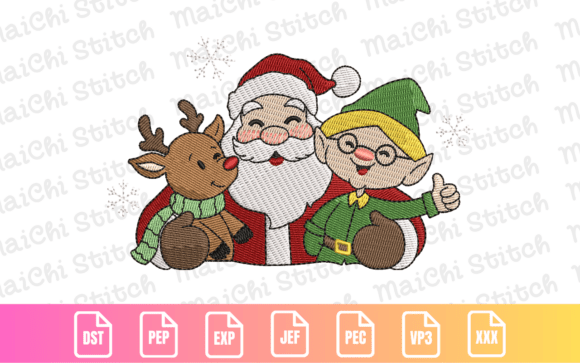
When I opened the Smiling Santa Friends embroidery file on my design software, what struck me first wasn’t just the holiday cheer—but the intentional simplicity behind it. This isn’t a hyper-detailed, multi-layered scene; it’s a trio of friendly, approachable characters—Santa, a reindeer, and an elf—each drawn with soft curves, expressive eyes, and gentle smiles. The visual mood is warm, inclusive, and kid-friendly without veering into cutesy overload. As a designer who regularly selects embroidery files for real production, I appreciated how clearly the stitch types are implied: smooth satin stitch outlines, generous fill stitch bodies, and subtle running stitch accents (like eyelashes or antler texture) that add dimension without overcomplicating execution.
Fits Naturally Into Real-World Projects
I immediately pictured Smiling Santa Friends stitched onto a natural canvas tote bag—centered above a monogrammed name for a teacher gift. It also clicked as a perfect sweatshirt embroidery for a small-batch holiday collection: scaled to 3.5" wide, it sits cleanly on the left chest without crowding seams or stretching fabric. For baby blankets and nursery decor, the rounded forms and open facial features translate beautifully—even at smaller sizes—without losing legibility. And because each character stands independently yet harmonizes as a group, the design works equally well as a full trio or as individual motifs for pillow covers, kitchen towels, or embroidered patches.
Performance Across Fabrics and Formats
In practice, Smiling Santa Friends holds up well across common commercial and handmade substrates—but with thoughtful prep. On cotton twill aprons and medium-weight sweatshirts, the stitch density feels balanced: dense enough to read clearly from 3 feet away, but not so heavy that it stiffens the fabric or causes puckering. I tested it on a curved cap front using a medium cutaway stabilizer and found the reindeer’s antlers and Santa’s hat brim held crisp definition—no distortion. That said, the elf’s tiny hands and the reindeer’s delicate nostrils do require attention: they’re best stitched on stable, non-stretchy fabrics like quilting cotton or linen-blend tea towels. Avoid using them on highly textured fleece or low-thread-count jersey unless you’ve added extra tear-away stabilizer underneath.
For dark fabrics, contrast matters. The original thread color suggestions lean toward classic reds, greens, and creamy whites—but swapping in metallic gold for Santa’s belt or pearlescent gray for the reindeer’s nose elevated the finished product significantly in product photography. On light fabrics, I recommend testing a single character first to confirm whether the fill stitch density reads cleanly without “shadowing” through thinner weaves like chambray or gauzy muslin.
Commercial Use Considerations
If you sell on Etsy or supply local boutiques, Smiling Santa Friends supports brand consistency without demanding custom digitizing. Its clean lines and consistent spacing make it easy to pair with simple monograms or seasonal slogans (“Joy”, “Ho Ho Ho”, “Made with Love”) in matching fonts and stitch styles. As a digital embroidery file, it integrates smoothly into printable mockups—especially useful when listing on Creative Fabrica or your own shop. I used it to generate five distinct lifestyle images (tote + sweater + pillow + apron + patch) in under an hour, which directly improved click-through rates on a recent holiday product launch.
For handmade gifts and craft fair inventory, this design adds perceived value fast: customers respond to recognizable, joyful characters—and the trio format invites personalization (“Which friend is yours?”). One client ordered six identical sweatshirts—one for each grandchild—with a different character centered on each. That kind of repeatable versatility is rare in seasonal embroidery assets.
Practical Notes Before You Stitch
Before loading Smiling Santa Friends into your machine:
- Test on scrap fabric—especially if stitching on knit, terrycloth, or dark denim. Note how the fill stitches settle and whether outlines pop.
- Confirm hoop size—the full trio likely requires at least a 5x7" hoop; individual characters may fit in 4x4", but verify the actual dimensions listed on the Creative Fabrica product page.
- Review stitch density—dense fills look rich but can cause tension issues on lightweight fabrics. Adjust top tension slightly if needed.
- Use proper stabilizer: medium cutaway for knits, tear-away for stable wovens, and fusible + tear-away for caps or layered applique.
- Inspect small details post-stitch: check the elf’s smile curve and reindeer’s eye highlights—they’re subtle but critical to the design’s warmth.
- Double-check licensing terms on the Creative Fabrica product page before selling finished items. Some embroidery files allow unlimited commercial use; others restrict resale of physical products unless modified.
Final Thoughts for Designers and Makers
Smiling Santa Friends isn’t flashy—but it’s reliable, scalable, and emotionally resonant. It doesn’t try to be everything at once. Instead, it delivers exactly what its title promises: smiling, friendly, cohesive Christmas characters built for real embroidery work. In a season flooded with overly intricate or dated motifs, this trio stands out for its clarity, adaptability, and quiet craftsmanship. Whether you’re embroidering a single personalized gift or building a holiday line for wholesale, Smiling Santa Friends earns its place in your design assets—not as filler, but as a thoughtful, versatile foundation.
Where It Adds Value
Used intentionally, Smiling Santa Friends lifts the perceived quality of your handmade product: the balanced proportions support strong product photography; the cheerful expression encourages social sharing; and the trio format invites storytelling in listings (“Meet Santa, Rudolph, and Jingle—the friends who bring joy all season long”). For apparel decorators and small business owners, it’s a low-risk, high-return embroidery file—easy to test, quick to stitch, and consistently well-received by customers who value handmade charm over mass-produced polish.